COD/CSD ID: 1544226 Raw Tensor Data
Unit Cell Details:
| Crystal Name | urea | |||
|---|---|---|---|---|
| Chemical Formula | CH4N2O | |||
| Hermann-Mauguin Space Group | P21212 | |||
| Lattice Constants | a | 3.41Å | α | 90° |
| b | 7.36Å | β | 90° | |
| c | 4.61Å | γ | 90° | |
| Cell Volume | 115.7 Å3 | |||
Predicted Material Properties:
Piezoelectric Strain Constants [pC/N]:
| 0 | 0 | 0 | 23.36 | 0 | 0 |
| 0 | 0 | 0 | 0 | -171.17 | 0 |
| 0 | 0 | 0 | 0 | 0 | -4.6 |
Elastic Constants [GPa]:
| 23.42 | 11.12 | 11.64 | 0 | 0 | 0 |
| 11.12 | 26.93 | 24.8 | 0 | 0 | 0 |
| 11.64 | 24.8 | 74.73 | 0 | 0 | 0 |
| 0 | 0 | 0 | 14.38 | 0 | 0 |
| 0 | 0 | 0 | 0 | -0.71 | 0 |
| 0 | 0 | 0 | 0 | 0 | 8.52 |
| Eigenvalues of the Elastic (Stiffness) Matrix | |||||
|---|---|---|---|---|---|
| λ1 | λ2 | λ3 | λ4 | λ5 | λ6 |
Predictions and Analysis (auto-populated):
Mechanical Stability Analysis:
For this crystal, the diagonal elastic constants (C11-C66) were evaluated. One or more values are below 1 GPa, which may indicate extreme softness, unreliable predictions, or potential mechanical instability. Negative diagonal elements provide a indication of instability. This assessment ensures that the material can withstand mechanical loads and that extremely soft or unstable crystals are properly identified.
The elastic stiffness tensor 𝛛, represented by components Cij (with indices i,j = 1…6), governs the crystal’s mechanical response. The bulk modulus K in Voigt notation, a measure of resistance to uniform compression, is estimated at 24.47 GPa, while the average shear modulus G in Voigt notation, indicative of resistance to shear deformation, is approximately 7.4 GPa. The elastic constants span a range from -0.71 to 74.73 GPa, reflecting the variation of stiffness across crystallographic directions. An anisotropy ratio A = -20.25 (the ratio between the maximum and minimum shear modulus components) reveals a relatively isotropic elastic response. Together, these parameters provide fundamental insight into the crystal’s mechanical stability and anisotropic elastic properties, essential for understanding its deformation and performance under applied stresses.
Based on the Hill averages, this crystal exhibits a bulk modulus K = 21.25 GPa, Young’s modulus E = 6.55 GPa, shear modulus G = 2.26 GPa, and Poisson’s ratio ν = 0.449. The Young’s modulus classifies this material as very soft, reflecting its mechanical stiffness. The Poisson’s ratio indicates the balance between volumetric and shear deformation under stress, consistent with typical crystalline solids. These elastic properties provide key insights into the crystal’s mechanical stability and deformation behavior.
Piezoelectric Strain Evaluation:
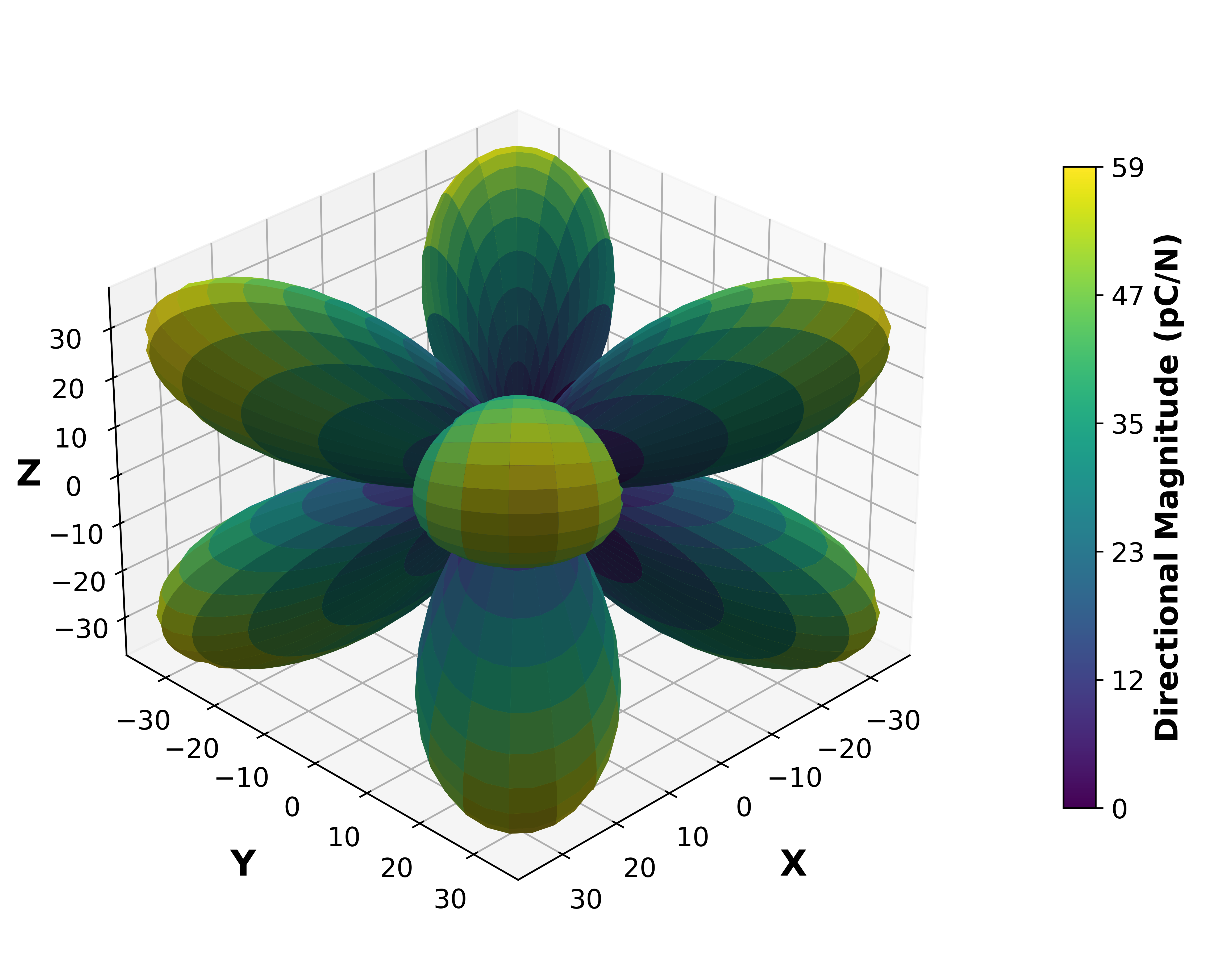
The predicted value of the effective longitudinal piezoelectric strain, d33eff. coefficient is 0 pC/N, indicating the strain response along the principal axis when an electric field is applied. The maximum strain coefficient across the tensor is 171.17 pC/N, showing the strongest piezoelectric coupling component. Shear coefficients such as d15 = 0 pC/N, d14 = 23.36 pC/N, d25 = 171.17 pC/N and d36 = 4.6 pC/N demonstrate the crystal's ability to undergo shear deformation. The anisotropy ratio of approximately 37.21 suggests significant directional variation in piezoelectric response, typical of low symmetry materials. Note: The effective longitudinal piezoelectric coefficient d33 corresponds to the maximal response along the principal crystallographic axes and can be measured experimentally using a piezometer or equivalent setup on single crystals. These strain coefficients are in picocoulombs per newton (pC/N). Such experimental measurement techniques aligned with crystallographic axes, can validate these predictions (Guerin et al., 2017).
Note: As the crystal shows flagged values in either the elastic matrix (diagonal element < 1 GPa) or negative eigenvalues, the piezoelectric predictions may not be reliable.
Full CrystalCard raw data file can be downloaded from here .
2D Plots of the Elastic Tensor (C):
|
3D Plot of the Piezoelectric Tensor (d):
|